

Hello everyone – this blog is the first in a series of blogs exploring some interesting objects and places around our area. Evelynne is our visitor centre assistant and she’s been doing a bit of research on the Brethren Well which is situated on the hill behind the museum overlooking the bay and next to the Reisgill Burn. If you have any knowledge of the well or any pics you’d like to share forward them on to us at info@waterlineslybster.co.uk, Evelynne will keep building on the blog as she finds out more.
My name is Evelynne, I am the new(ish) Visitor Centre Assistant at Waterlines Heritage Museum.
First of all, I would like to thank the following people: Donna Booth, Ian Leith, Sara Campbell, Shena McBeath, Jane Coll (Northern Saints Trail), Ann Mackay (Nucleus Archives), Dr Oisin Plumb, Alasdair Cook, Nikki Cook and Charlotte Cook.
All of the names mentioned above have all helped me with my research. Thank you all.
In this blog I will be talking about my findings of my research project of the Brethren Well in Lybster.
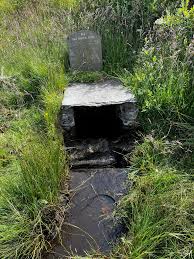
The aims of this project were to investigate if there is a possibility of there being a Monastery in the surrounding area of the Well of The Brethren (Brethren Well), to investigate which missionaries/monks that came to Lybster during the time period of the Pictish stone found at the Well of The Brethren. The other aim of this project was to investigate the previous and current names for Lybster and to research the meanings.
This project was primarily desk based using both online and physical resources. For example: Book of Lybster by Donald Young (Physical) and the Old Norse dictionary (Online).
The previous name for Lybster was Haligeo.
Hali-/Helgi- meaning Holy or Sacred.
-geo meaning narrow sea inlet/cleft or a ravine cut by the sea.
So, the old Norse name for Lybster was roughly translated to Sacred or Holy Inlet.
Although I cannot find the meaning of the current name for Lybster, I translated it into Gaelic.
Lybster translates to Liabost in Gaelic.
There is no direct translation so we can only speculate.
You could break the into Li(a)- and -bost and translate it into norse, meaning slope or stone farm. Or farm on the hillside.
Or, Lia- could be a person’s name. It could also be the colour grey shortened, Liath.
Or, standing stone.
To back this up I looked at the Gaelic translation of the Stone of Scone (AKA Stone of Destiny), and that is Lia Fàil.
I would like to say that it could be a slope or stone farm.
But, what is this potential stone?
It could be referring to Hill O’ Many Stanes, Achavanich or Camster Cairns.
Or, it could be referring to the Pictish stone found by the Brethren Well.
Perhaps it’s wishful thinking, but I would like to think that it could be referring to the Pictish Stone.
The term “Brethren” primarily means “Brothers” in a biblical context, referring to fellow believers who share a spiritual bond through faith.
The Brethren Well is believed to have had continuous use for over 1500 years.
It is said that it was used by the MacDonald family until 1955.
Research is still ongoing in regards to finding out more information about the family.
The Brethren Well was rebuilt, and the completion was in April 2004.
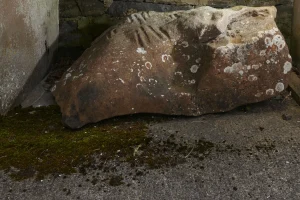
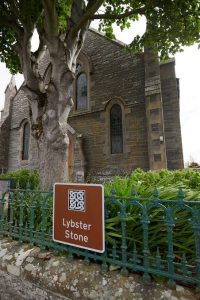
There was a Pictish Stone found at the Brethren Well, said to be first recorded in 1726. When the stone was initially recorded youths were found attempting to roll the stone down the hill.
The stone is now at a Church in Lybster. It is said to have been dug up near the well during the construction of Lybster Harbour in the 18th century. There is a gravestone style plaque at the Brethren Well currently.
The Pictish stone originally found at the Brethren Well is a Class IV Pictish Stone. A Class IV Pictish Stone isn’t widely recognised – in fact it was extremely difficult to find information on this.
A Class IV Pictish Stone in today’s classing system is an early Medieval (Pictish) Sculpture. It refers to undressed or roughly shaped monuments only having Crosses, no pagan or secular symbols.
Many records state different dates. Historic Environment Scotland (HES) records estimate between 561 AD to 1057 AD. Other records estimate between the 6 to the 8th century.
The Brethren Well is said to be used for Baptisms, Drinking water and daily life things. I DO NOT recommend drinking from the Well. It can make you ill (Donna learned from making this mistake). The What3words for the Brethren Well is: ///method.venturing.vest
The Christian influence began as early as the 5th Century AD in Scotland. An example is Whithorn Priory, a St. Ninian’s shrine originally. This is in Dumfries and Galloway. Sources estimate different dates as to when it first started, some as early as 387 AD. Historians and Archaeologists believe that this is one of the first influences of Christianity in Scotland. Albeit, this is further South to where my research is based. Saint Columba is said to have had a big influence on Scotland regarding Christianity. Saint Columba was from Donegal of Ireland. There is no recorded timeline of when Saint Columba first came to mainland Scotland. Saint Columba’s famous Monastery is on an Inner Hebridean island called Iona, where it is said that Mary Magdalene is buried. This was said to be the main hub for converting the Picts and teaching them the Christian ways. Saint Columba founded the Hiberno Scottish Mission AKA Celtic Christian Mission. This mission consisted of religious expeditions, which were initiated by Gaelic clerics from Ireland and Western Scotland between the 6th and 8th Centuries AD. They aimed to spread Christianity and establish monasteries across England, Scotland, Wales, Germany, France and Switzerland. Some of the missionaries included: Saint Columba, Saint Aidan, Saint Columbanus and Dunod.
The Highland Pictish Trail said: “The Lybster stone almost certainly reflects the Christianisation of the Picts, a movement traditionally associated with St Columba among others. But there is no evidence that the stone itself was carved by Columban missionaries or that it marks a direct foundation of St Columba”. However, based on what we know we can only take an educated guess or speculate. There is no record in historical sources of a missionary establishing a presence in Lybster in this time period. The Monks most likely had the greater influence. But, we will never truly know. During this time period the Celtic Christian Mission had the largest influence on Scotland, from what we know. They established monasteries in places in the Highlands such as Inverness.
Another missionary, Saint Moluag. From the same time period as Saint Columba. Born in Ulster established Monasteries too. Some as North as Rosemarkie (Fortrose). However his itinerary was not all recorded so for all we know that was the furthest North he went.
One other possible missionary is Saint Maelrubha. He was from Bangor, Ireland. Saint Maelrubha established a Monastery in Applecross, 673 AD. Saint Maelrubha is said to be buried at the Monastery in Applecross. Now known as Clachan Church. It is said that he has travelled as far North as Durness/Farr. It is suggested that he travelled to Loch Shin, Loch Broom, Durness/ Farr and Keith. The Monastery established in Durness/Farr is now Balnakiel Church. It was said to have been reconstructed in the early 1600s. Which I believe are now the current remains that you see. However, it would be safer to scratch these ideas as there is no concrete evidence that Saint Maelrubha himself came to Caithness.
Now, onto the question, could there have been a Monastery in the Brethren Well, or Lybster Harbour area? There is no firm archaeological evidence to say that there was a Monastery in this area so it remains a question rather than a claim. There is a possibility of a Monastery being in the area of the Brethren Well and Harbour area. Looking at the ‘clues’ of the Cross Incised Stone and the Brethren Well, it appears to have been a very holy area. On the Highland Historic Environment Record, I was conducting some research and discovered a mention of a Lybster Harbour Chapel. Unfortunately there isn’t much information on this Chapel, yet.
In conclusion this has been a fairly successful report despite the limited sources. From the information provided from the sources, I would say there is a chance of there being a Monastery in the surrounding area of the Well of the Brethren.
So, at this time, who was more likely to have an influence on the Picts? Well, we will never truly know. Unless we find some sources that say for definite. We should not let it cloud the different possibilities though.
Masonic halls, such as the Masonic Hall in Thurso, was built in 1873. The Church in Latheron was built in 1734, but supposedly has ties to the 13th century AD. Unfortunately, these are too late in time for what we were looking for.
Thank you for reading!
If anyone have any information, or has any questions, please contact the Waterlines page or email us at:
If you would like to see the references, they are all compiled into the following document:
https://docs.google.com/document/d/1m2Vl8NVKrfwp_2jLO3ddblqlEdyPLeSoCkt0T3M-HZQ/edit?usp=sharing


 Waterlines — The Story of Lybster